The Lynes ladder
In 1949 LIFE drew a chart on which you could read off whether your taste was high or low. The salad column shows what has happened to that ladder since.
Russell Lynes was an editor at Harper’s. In February 1949 he published an essay sorting Americans into four kinds: high-brow, upper middle-brow, lower middle-brow and low-brow. Two months later LIFE turned it into a chart, drawn by Tom Funk. Eleven columns, four rows, from clothes and furniture to records, games and causes.
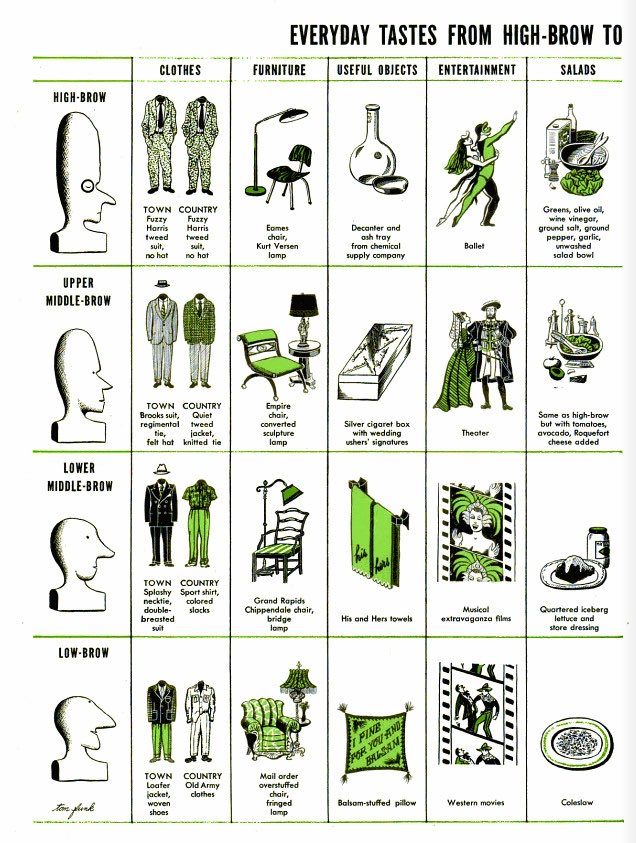
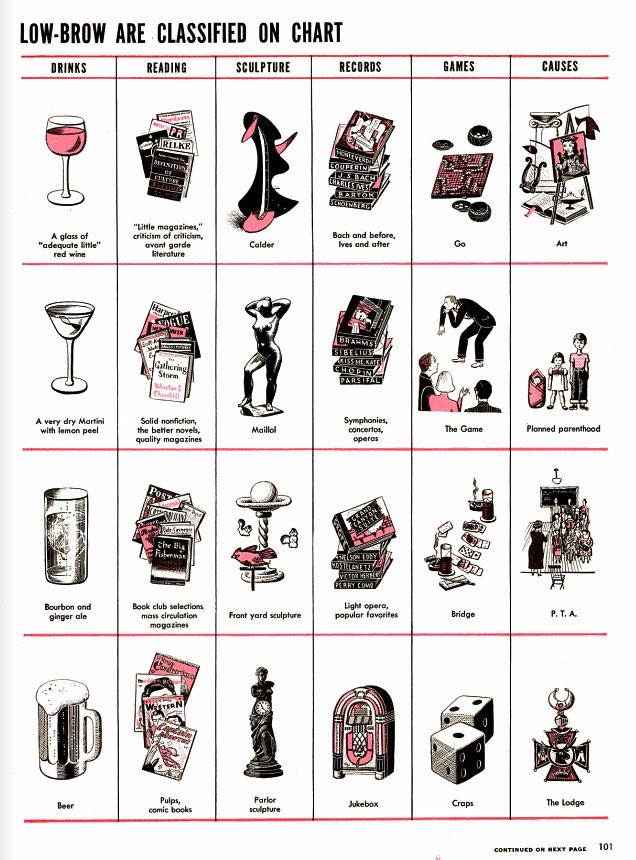
What the chart does is tell a reader where he stands. The high-brow wears Harris tweed without a hat, sits on an Eames chair, goes to the ballet and drinks a glass of “adequate little” red wine. The low-brow has a mail-order chair, watches westerns and drinks beer. In between sit two layers made of not quite.
So the ladder was on the newsstand thirty years before Pierre Bourdieu published La Distinction. With the opposite claim attached. Lynes argued that rank and money no longer decided what a person liked. This is what strikes me first. In Taste after the elite I wrote that the charge of snobbery comes from Bourdieu. For the theory that holds. The form is older. It came out of a mass magazine with millions of readers. LIFE described the ranking and taught its readers to read it off. That is how it sold the unease it was writing about.
The second thing is the salad column, and it cuts deeper than the rest.
High-brow, 1949: greens, olive oil, wine vinegar, ground salt, ground pepper, garlic, unwashed salad bowl. Upper middle-brow: the same, with tomatoes, avocado and Roquefort added. Lower middle-brow: quartered iceberg lettuce and dressing from a bottle. Low-brow: coleslaw.
Now read those four as a single shopping list. The high-brow vinaigrette stands in every Dutch kitchen, including the bowl you rub with half a clove and do not rinse. Avocado is in every supermarket and Roquefort in most. Quartered iceberg under thick dressing is back on restaurant menus as the wedge salad, with bacon and blue cheese. Coleslaw sits at the butcher’s.
The ladder has become a shelf. The bottom rungs did not climb and the top ones did not come down. Industry bought all four, laid them side by side, and now sells every level to everyone. What gave away your position in 1949 is a choice from a range.
The chart has not been refuted. It has been outlived. The idea that taste is a ranking has digested its own contents. The things in the boxes have shifted or gone. The boxes are still there, waiting to be filled again. Which happens. In August 2026 Kazys Varnelis filled the eleven columns in afresh, same form, new contents. His dividing line runs horizontally. The upper middle row takes its taste from institutions, from museums and critics, the lower one from platforms, from rankings and recommendation engines. Price runs diagonally, since the top row can come from a thrift store. A version for the world of artificial intelligence is also going round, with columns for models, charts and forecasts. In that chart too, the high-brow marks himself by leaving something out. In 1949 a tweed suit without a hat; now a base model without a chat template and a loss curve without axis labels. Say today that one croquette is the real thing and the other is filler in breadcrumbs, and you will be suspected of reading that chart. Even when you are only tasting.
The suspicion is wrong, and it is older than the sociology said to have caused it.
Source: Russell Lynes, ‘Highbrow, Lowbrow, Middlebrow’, Harper’s Magazine, February 1949. The chart appeared two months later in LIFE, drawn by Tom Funk. Lynes expanded the essay into The Tastemakers (Harper & Brothers, 1954). The August 2026 revision is by Kazys Varnelis, The Tastemakers, 2026, varnelis.net, with the accompanying chart at data.is-lost.org/tastemakers.